In addition to being a pretty good all-around athlete, competitive within her age group, CRR Sue Barton recently received plaudits for her professional work as a University of Delaware horticulturist.
“Sue Barton’s role at the University of Delaware is the perfect embodiment of the University’s land-grant mission. She teaches. She conducts research. And she takes UD’s knowledge to the public.”
Of course, we also know Barton for her winning qualities as a competitive triathlete and a world age-group CrossFit champion in 2019!
Kudos to you, Sue, for making such an impact within your field.
The Delaware Mile Challenge was a unique event, to be sure, on the recently renovated track at The Tatnall School. On Saturday evening, April 9, runners of all ages took to the track to challenge the mile distance. Well after dark, the excitement had built to a crescendo, as the elite men and women took to the oval to compete.
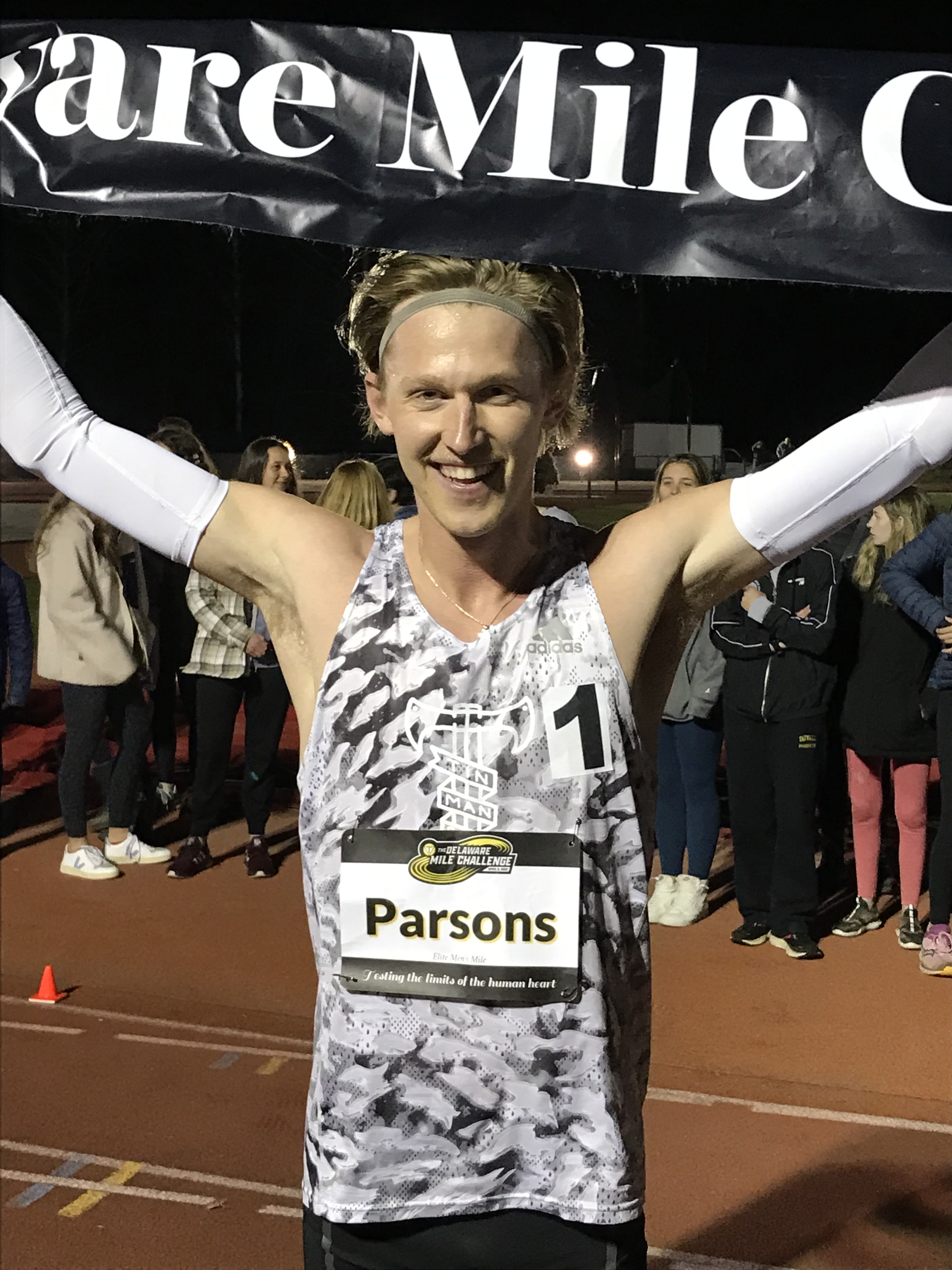
A victorious Sam Parsons is all smiles after clocking the first sub-4 mile in Delaware.
“Homefield” advantage theoretically should have meant nothing, as among the field of 13 elite men there were four runners who had already broken the 4-minute-mile barrier at least once. One of those competitors, however, was CRR Sam Parsons (son of CRR George Parsons and CRR Christina Parsons), who grew up in Newark and ran track and cross country for Tatnall during his high school years.
It appeared early on in the men’s elite feature race that Parsons, who trains with Colorado-based Tinman Elite, was ready for the challenge. Through the initial lap, he was in good position in fourth. Moving up, he took over third during the second lap, staying close to a 60-seconds-per-lap pace while battling with three professional runners from Baltimore’s Under Armour club—two in front of him and one right behind him.
By the back stretch of the final lap, Parsons had moved up and positioned himself right behind the race leader, Casey Comber. With just a half lap to go, both were right around 3:30, setting up what would be a frenetic sprint finish.
With the volume increasing to a roar from the hundreds who lined the track to cheer him on, Parsons out-sprinted Comber on the final straightaway and, in doing so, eclipsed the 4-minute mark—the first time this had been done on Delaware soil. Parsons clocked in at 3:58.17; Comber finished just 0.27 seconds behind, also going sub-4. The previous best mile run in Delaware had been run 50 years ago, indoors, at 4:01.1.
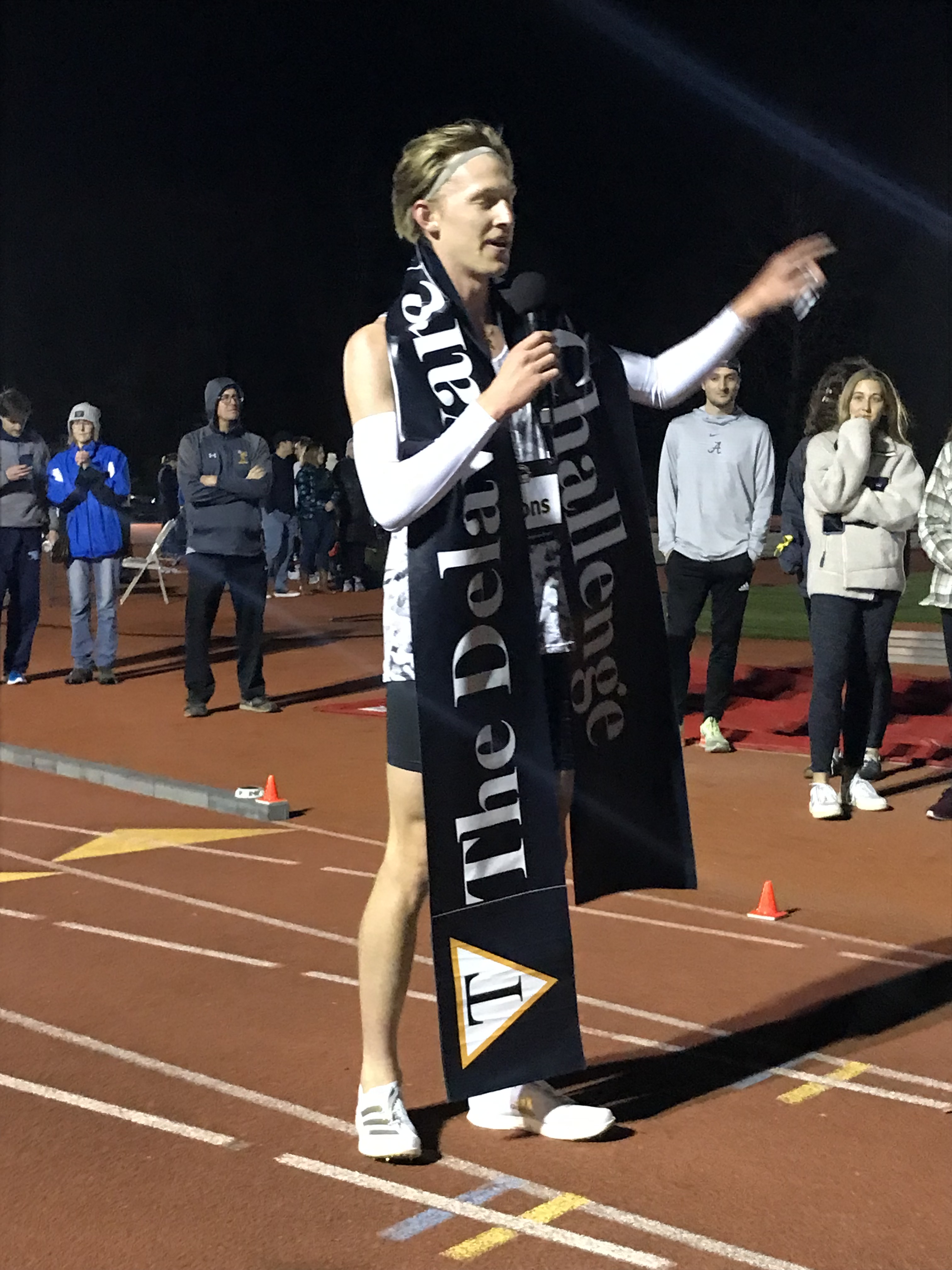
Sam Parsons addresses the crowd after his historic win.
While not taking a victory lap, Parsons did take the mic to thank the crowd for helping to make The Delaware Mile Challenge such an energy-filled and memorable event. He also thanked his high school coach, Pat Castagno, who is Tatnall’s track-and-field and cross-country coach and whose own coach while at the University of Delaware was Delaware’s legendary CRR Jim Fischer, who presented the master’s mile race during the event.
By winning the elite race, Parsons bagged $2,500 in prize money. By breaking the 4-minute mark, he also walked (or maybe ran?) away with a $500 bonus, making it a very satisfying (and profitable) trip home!
The elite women’s winner, Molly Sughroue, of the Colorado Springs Track Club, ran away with the race, a new in-Delaware women’s record, and the same prize money.
Collectively, Creek Road Runners congratulate one of our own. Way to go, Sam!
Of local note is the fact that CRR Jim Bray, a Newark High School alum, once held the Delaware high school mile record for 28 years before it was broken in 1999.
The world record in the mile is still a mind-boggling 3:43.13, set by Morocco’s Hicham El Guerrouj in 1999.
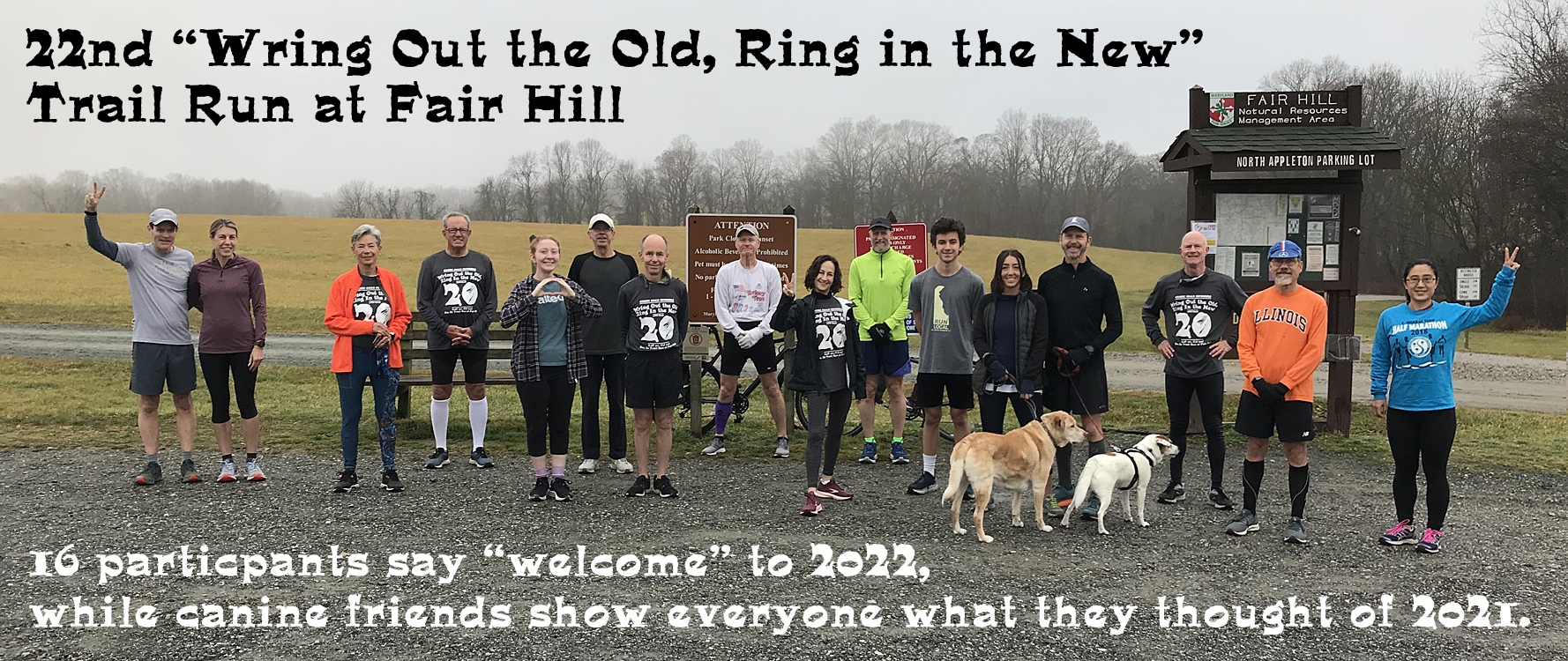
On December 31st, we renewed a yearly Creek Road Runners tradition that we had to pull the plug on in 2020. Sixteen participants and two dogs showed up to enjoy the unseasonably warm weather. We managed to get a decent group shot and keep a reasonable social distance.
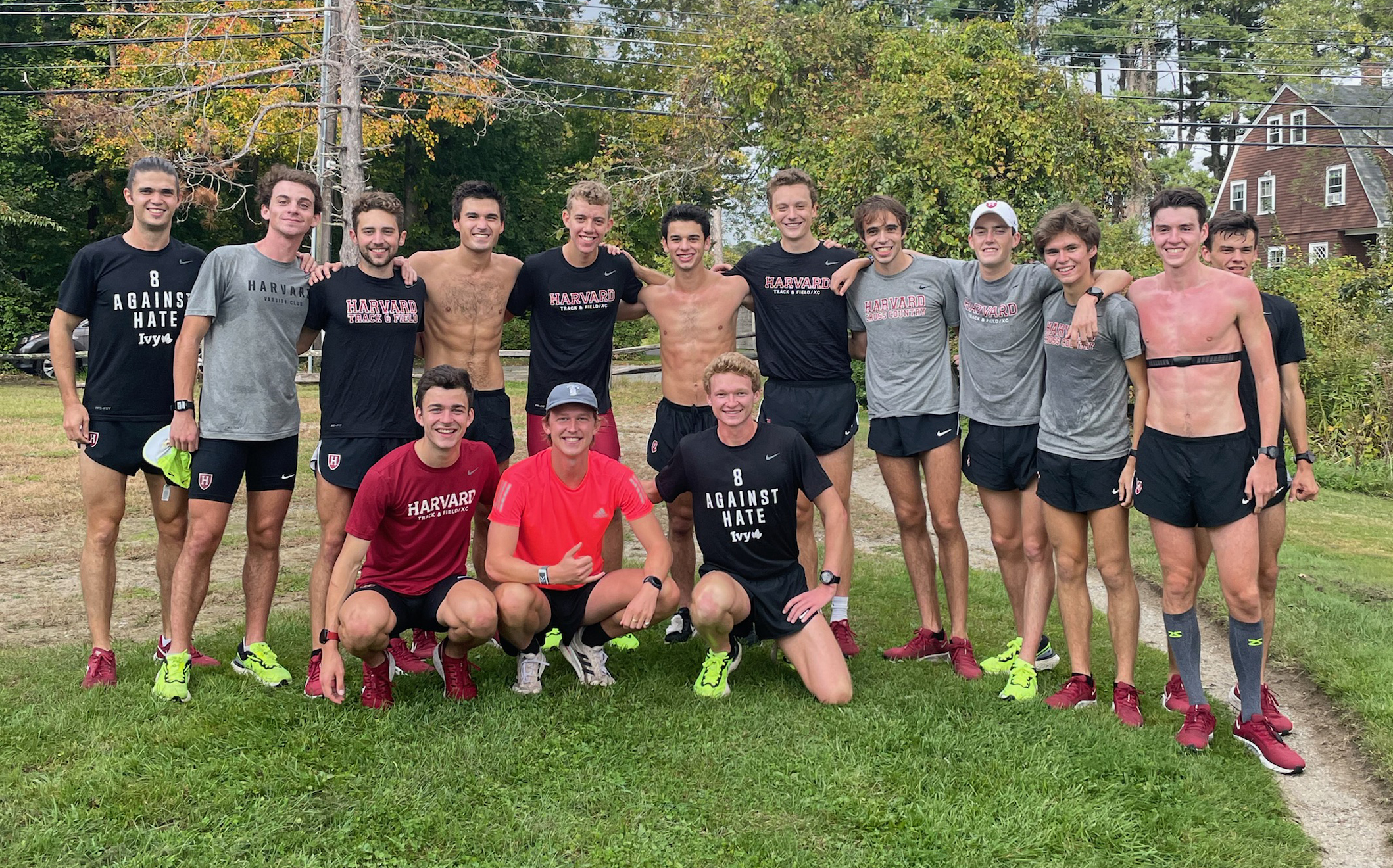
Last month, CRR Sam Parsons ventured to Cambridge, Mass., and hooked up with the Harvard University men’s running team. So, why was the Newark native and Tatnall School and NC State grad with the Crimson? Well, it probably had something to do with Harvard’s recent (and not-so-recent) Delaware connection.
In the above photo (submitted by CRR George Parsons, Sam’s dad), Parsons is kneeling, front and center in the gray hat and bright red shirt. Behind him and to his left, sans shirt, is Andrew Avila, a Harvard sophomore from Newark, who ran for the Charter School of Wilmington.
Parsons, a professional runner with Boulder, Colo.–based Tinman Elite, knows former Harvard runner and Charter School of Wilmington standout Kieran Tuntivate (not in the photo), who now runs for the Bowerman Track Club in Portland, Ore. No doubt Parsons and Tuntivate had kept in touch while Tuntivate was running for the Crimson.
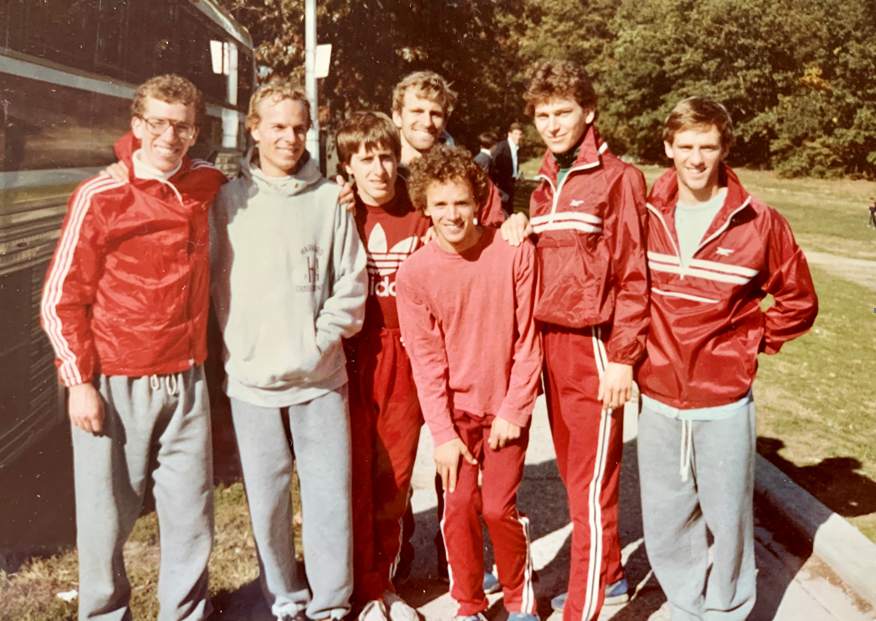
CRR Bruce Weber, a Harvard alumnus and local ambassador for the school, helped Tuntivate familiarlize himself with Harvard and its running program several years ago as he was making up his mind where to do his college running. Weber submitted his own archival tribute to the Crimson runners of yore, of whom he was a key player when he was an undergrad. In this photo from 1984, Weber, who is Dean of the Lerner School of Business at the University of Delaware, is second from the right.
CRR Barret Michalec touched based recently, sending in some of his thoughts and experiences from living and running in Arizona, where he moved about a year and a half ago.
I’ve been running here and there since moving to Arizona. I live in an area called Fountain Hills. It gets its name from the famous Fountain, and, of course, [there are] rolling hills…which I have learned about first-hand in my running. The heat is the kicker, can’t really get out any time after 9 a.m. in the summer and even late spring, but during the “winter” and “fall” it’s pretty fantastic running.
I haven’t been training or anything but saw a run that looked fun. It was a trail 15k in the local mountains…AT NIGHT! I hadn’t done much trail running because of the snakes and wildlife and fear of getting lost, but I figured I would be able to see all the other headlamps of fellow runners at this thing. It was super awesome. A bit scary, a bit like “They allow us to do this?!”
I ended up finishing in 1 hour and 20 minutes and came in 3rd [among] all men (4th overall out of 60+ [finishers]). What struck me was the age of the top—all over 40. Trail running must be something different out here—different crowd, different techniques/tactics. I couldn’t use my long strides because of the rocks and loose-footing areas on the uphills and downhills, and there are a lot of twists and turns, so you have to really focus…especially at night.
There were folks there for a 75k, 50k, and a 25k! NUTS! Maybe [I’ll do] the 25k next time though….
Barret, thanks for the update, and stay cool out there.